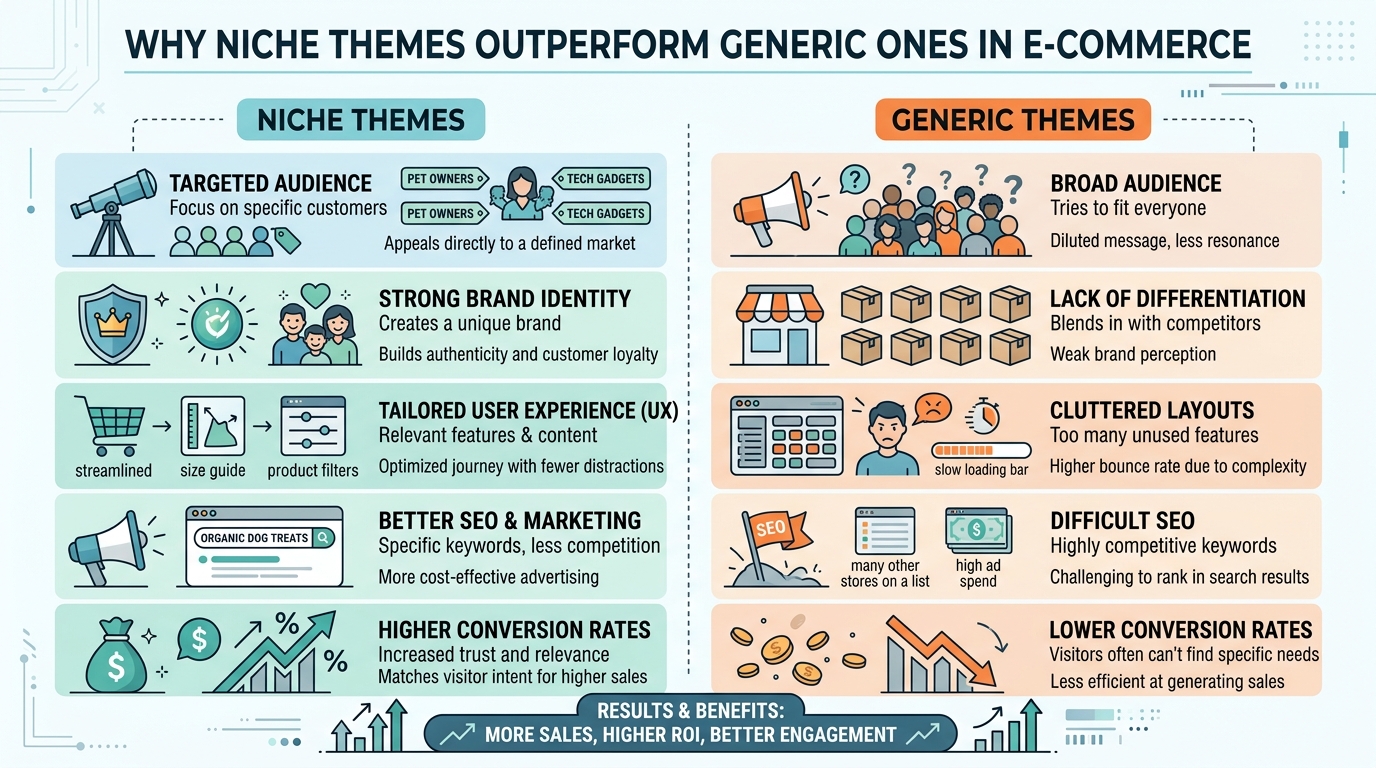
Why Niche Themes Outperform Generic Ones in E-commerce
Imagine walking into two stores. The first sells everything — electronics, clothing, furniture, pet supplies, and gardening tools all crammed under one roof with generic signage and a one-size-fits-all layout. The second sells only premium outdoor camping gear, with earthy tones, adventure photography, expert product descriptions, and a layout designed specifically for outdoor enthusiasts.
Which store makes you feel more confident about your purchase?
If you answered the second one, you already understand the core argument of this blog.
In the world of e-commerce, your website theme is your storefront. And just like physical retail, specialized environments consistently outperform generic ones. Yet thousands of online store owners make the costly mistake of choosing broad, multipurpose themes when launching their shops — sacrificing conversions, brand authority, and customer trust in the process.
In this blog, we’ll explore exactly why niche themes outperform generic ones in e-commerce, backed by real data, practical insights, and actionable takeaways.
What Is a Niche Theme vs. a Generic Theme?
Before diving in, let’s define our terms clearly.
Generic Themes
Generic or multipurpose themes are designed to work for any type of store. Think of popular options like general-purpose Shopify themes or WordPress themes marketed as “suitable for all industries.” They offer:
- Broad layout options
- Neutral color palettes
- Standard navigation structures
- One-size-fits-all product display formats
Examples: A theme that can be used for a jewelry store, a hardware store, and a software company without changing much.
Niche Themes
Niche themes are purpose-built for specific industries, audiences, or product types. They’re designed with a deep understanding of:
- What the target customer expects to see
- How products in that category are typically browsed
- The emotional triggers that drive purchases in that space
- Industry-specific trust signals
Examples: A theme built specifically for pet stores, luxury fashion brands, health supplements, handmade crafts, or electronics retailers.
5 Core Reasons Why Niche Themes Outperform Generic Ones
1. 🎯 They Create Instant Emotional Connection
When a customer lands on your website, you have roughly 3 to 5 seconds to make an impression. In those critical moments, your theme either speaks their language or it doesn’t.
Niche themes are designed with a specific buyer persona in mind. Every color choice, font selection, image style, and layout decision is made to resonate with a particular type of customer.
Consider this comparison:
| Element | Generic Theme | Niche Theme (Fitness Equipment) |
|---|---|---|
| Color Palette | Neutral blues and greys | Bold blacks, reds, and energetic tones |
| Typography | Standard serif/sans-serif | Strong, impact-oriented fonts |
| Hero Section | Generic product display | Action photography of people working out |
| Messaging Tone | “Shop our products” | “Push your limits. Build your best self.” |
| Social Proof | Basic star ratings | Before/after transformations, athlete endorsements |
The niche theme immediately tells the fitness enthusiast: “This store was built for you.”
That emotional alignment directly translates to:
- Lower bounce rates
- Higher time-on-site
- Stronger purchasing intent
- Increased brand recall
2. 🔍 They Improve SEO Performance
Search engine optimization isn’t just about keywords and backlinks. Your theme’s structure plays a massive role in how Google perceives your store.
Niche themes tend to outperform generic ones in SEO for several important reasons:
a) Cleaner, Focused Code Architecture
Generic themes carry the weight of supporting hundreds of use cases. This means bloated code, unnecessary scripts, and slower load times. Niche themes are streamlined for one purpose — resulting in:
- Faster page load speeds (a direct Google ranking factor)
- Cleaner HTML structure
- Better Core Web Vitals scores
b) Industry-Aligned Schema Markup
Niche themes often come with pre-built schema markup relevant to their industry. A recipe store theme might include Recipe Schema. A real estate theme might include Property Schema. This helps Google better understand your content and can earn rich results in search listings — giving you more visibility than competitors using generic themes.
c) Better Content Hierarchy
Because niche themes understand their audience’s search behavior, their layouts naturally support better content hierarchy — making it easier to create pages that align with how customers search for products in that category.
The result? Stores using purpose-built themes tend to rank higher for category and product-specific keywords, driving more organic traffic over time.
3. 💳 They Drive Higher Conversion Rates
This is perhaps the most compelling argument for niche themes, and the numbers back it up.
Conversion rate optimization (CRO) is the science of turning visitors into buyers. Niche themes have a structural advantage here because they’re designed with industry-specific buying behavior in mind.
Understanding Buyer Behavior by Niche
Different product categories have completely different customer journeys:
- Luxury fashion buyers need large editorial images, minimal clutter, and an air of exclusivity
- Electronics buyers need detailed spec comparisons, compatibility information, and trust badges
- Food and beverage buyers need sensory photography, ingredient transparency, and lifestyle imagery
- Health supplement buyers need scientific credibility, customer testimonials, and clear dosage information
A generic theme tries to serve all of these equally well — and ends up serving none of them perfectly.
A niche theme is engineered to remove every possible friction point specific to that buying journey.
Real-World Impact on Conversions
Studies consistently show that tailored user experiences increase conversions:
- Personalized calls-to-action convert 202% better than generic CTAs (HubSpot)
- Relevant visual design increases purchase intent by up to 40% (Nielsen Norman Group)
- Page load time improvements of just 1 second can increase conversions by 7% (Akamai)
Niche themes contribute to all three of these areas by delivering relevance, emotional resonance, and technical optimization simultaneously.
4. 🏆 They Build Stronger Brand Authority and Trust
In e-commerce, trust is the currency that drives sales. Customers buy from stores they believe in — and niche themes help you build that belief faster.
Why Generic Themes Erode Trust
When customers see a generic theme, several subconscious concerns can emerge:
- “Does this store specialize in what I need, or are they just selling everything?”
- “This looks exactly like a dozen other stores I’ve visited.”
- “They don’t seem to really understand what I’m looking for.”
These doubts create hesitation — and hesitation kills conversions.
How Niche Themes Build Credibility
Purpose-built themes communicate expertise through design. When a medical supply store uses a theme with clean clinical aesthetics, proper medical imagery, and compliance-focused trust badges, customers immediately perceive professional authority.
When an artisan craft store uses a theme with handmade textures, warm photography, and maker-story sections, customers feel they’re buying from a genuine, passionate creator.
This perceived expertise directly impacts:
- Customer confidence at the moment of purchase
- Average order value (people spend more with brands they trust)
- Return customer rates (brand loyalty starts with brand identity)
- Word-of-mouth referrals (distinctive brands are more memorable and shareable)
5. 📱 They Offer Industry-Specific Features That Generic Themes Simply Don’t Have
Perhaps the most practical advantage of niche themes is the specialized functionality they bring out of the box.
Generic themes are built around basic e-commerce features: product pages, cart, checkout, category listings. That’s the foundation. But every industry has unique needs that go far beyond the basics.
Examples of Niche-Specific Features:
🍕 Restaurant/Food Store Themes
- Menu display formats
- Reservation integration
- Ingredient and allergen tables
- “Order for pickup/delivery” workflows
💍 Jewelry/Luxury Themes
- 360-degree product view support
- Engraving customization options
- Size guides with visual aids
- Gift wrapping and special occasion messaging
👗 Fashion/Apparel Themes
- Advanced size and color variant displays
- Outfit builder or “complete the look” features
- Editorial lookbook layouts
- Trend and collection spotlight sections
🏋️ Fitness/Sports Themes
- Exercise video integration
- Product comparison for performance metrics
- Athlete testimonial formats
- Bundle builder for workout packages
💊 Health/Wellness Themes
- Supplement fact panel displays
- Subscription product support
- Clinical study citation sections
- Doctor/expert endorsement layouts
When you try to replicate these features with a generic theme, you’re either installing a pile of plugins (which slows your site and creates compatibility issues) or doing without (which hurts user experience and conversions).
Niche themes deliver these features natively — keeping your store fast, cohesive, and professionally designed.
Common Objections — Addressed
“But Generic Themes Give Me More Flexibility”
The reality: Most store owners don’t need infinite flexibility — they need the right flexibility for their specific use case. A theme with 500 layout options sounds impressive, but if none of them are optimized for your industry, that flexibility doesn’t convert into sales.
Niche themes give you focused flexibility — the ability to customize the elements that actually matter for your customers.
“Niche Themes Are More Expensive”
The reality: Compare the cost of a niche theme to the cost of lost conversions. If a specialized theme improves your conversion rate by even 0.5% on a store doing $10,000/month in revenue, the additional revenue quickly outpaces any premium you paid.
Furthermore, the cost of building niche-specific functionality on top of a generic theme — through custom development or multiple plugins — typically far exceeds the price difference.
“I Sell Multiple Product Categories”
The reality: Many stores that appear to sell multiple categories actually have a core customer identity. A lifestyle brand might sell clothing, accessories, and home goods — but they’re all serving the same type of customer with the same aesthetic sensibility.
The question isn’t “how many categories do I have?” but rather “who is my core customer?” If you can answer that clearly, a niche theme aligned to that customer will outperform a generic alternative.
How to Choose the Right Niche Theme
If you’re convinced it’s time to upgrade from a generic theme, here’s a practical framework for choosing the right one:
Step 1: Define Your Core Customer Identity
Before browsing themes, write down:
- Who is your ideal customer?
- What do they value most in a shopping experience?
- What emotions should your store evoke?
- What does “trust” look like in your industry?
Step 2: Research Industry Leaders
Look at the top-performing stores in your niche. Analyze:
- Their visual style
- Their navigation structure
- Their content approach
- The features they prominently use
This gives you a benchmark for what works in your space.
Step 3: Evaluate Themes Against Conversion Criteria
When reviewing potential themes, ask:
- Does the demo immediately communicate what the store sells?
- Are product pages optimized for how customers in this niche shop?
- Does it include industry-specific features natively?
- Is the page speed score acceptable (aim for 80+ on Google PageSpeed Insights)?
- Does it align with your brand’s desired emotional tone?
Step 4: Check for Mobile Optimization
Over 60% of e-commerce traffic comes from mobile devices. Ensure your niche theme is genuinely mobile-optimized — not just responsive, but designed with a mobile-first mindset.
Step 5: Review Support and Update History
A great theme with poor support is a liability. Check:
- When was the theme last updated?
- What do reviews say about customer support quality?
- Is it compatible with your platform’s latest version?
- Does the developer have an active community or documentation?
The Bottom Line
In e-commerce, relevance wins. The stores that consistently outperform their competitors aren’t necessarily the ones with the biggest marketing budgets or the widest product selections — they’re the ones that make every customer feel like the store was built specifically for them.
Niche themes are your most powerful tool for creating that feeling.
They create emotional connections that reduce bounce rates. They improve SEO through cleaner, purpose-built architecture. They drive higher conversions by removing industry-specific friction. They build brand authority through specialized design language. And they deliver the functionality your customers expect without the bloat and compromise of generic solutions.
The question isn’t whether you can afford a niche theme. The question is whether you can afford not to have one.
Ready to Make the Switch?
If you’re currently running your store on a generic theme and wondering why conversions aren’t where they should be, your theme may be the silent culprit.
Start by auditing your current theme against the criteria above. Ask yourself honestly: does this theme speak directly to my ideal customer? Does it make them feel like this store was made for them?
If the answer is no, it’s time to go niche.