How AI is Revolutionizing WordPress Web Development in 2026
As we navigate through 2026, the intersection of Artificial Intelligence and web development has moved far beyond simple chatbots and automated grammar checks. Nowhere is this transformation more evident than in the WordPress ecosystem. Powering over 40% of the web, WordPress has become the ultimate playground for AI integration, fundamentally changing how agencies, developers, and businesses build and manage websites.
What used to take weeks of coding, designing, and testing is now being orchestrated in a fraction of the time. Here is a look at how AI is revolutionizing WordPress web development today.
1. Natural Language Site Generation (Prompt-to-Website)
The days of starting a WordPress build by manually installing a theme, importing demo data, and replacing placeholder text are fading. In 2026, prompt-to-website generation is the new standard.
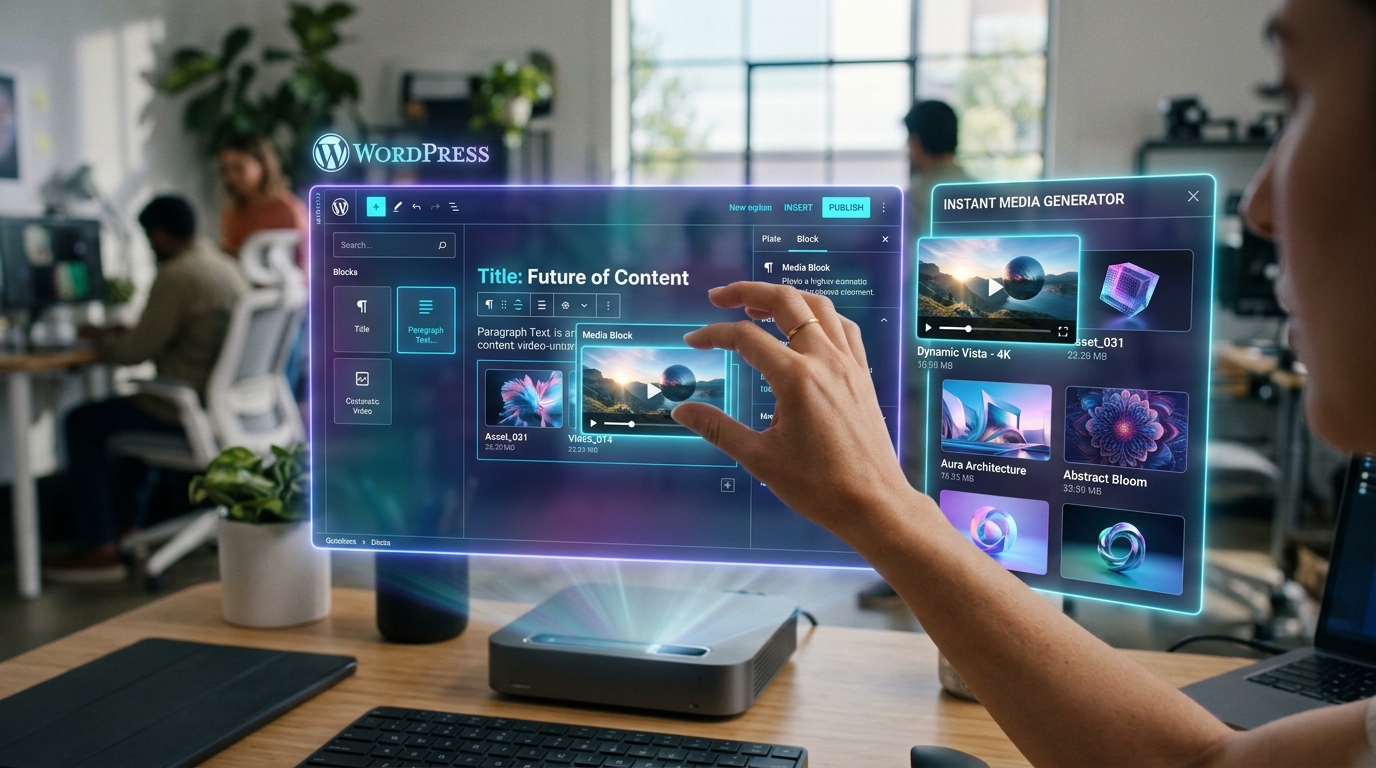
By integrating AI directly into the WordPress core and popular page builders, users can now type complex prompts like, “Build a dark-mode e-commerce site for artisanal coffee with a subscription portal, integrating WooCommerce and a minimalist aesthetic.” The AI automatically provisions the necessary plugins, generates custom Gutenberg blocks, drafts localized placeholder copy, and establishes the initial design system. Developers then step in to refine and customize, treating the AI’s output as a highly advanced wireframe.
2. Autonomous SEO and Real-Time Content Optimization
Historically, SEO plugins required users to manually input focus keywords and check off a list of best practices. Today, AI-native WordPress plugins act as autonomous marketing agencies.
These tools analyze current search engine algorithms in real-time, rewriting meta descriptions, structuring schema markup, and optimizing on-page content dynamically without human intervention. Furthermore, AI agents run continuous A/B tests on headlines and page layouts, serving the highest-converting variations to specific audience segments based on real-time browsing behavior.
3. Hyper-Personalization for the End-User
Static web pages are becoming a thing of the past. Through advanced AI algorithms, WordPress sites in 2026 dynamically adjust their content, layouts, and product recommendations based on the individual visitor.
If a B2B executive visits a SaaS website, the AI dynamically highlights enterprise features and white papers. If a small business owner visits the exact same URL, the site reorganizes itself to display affordable pricing tiers and quick-start tutorials. This headless-style personalization is now accessible directly within traditional WordPress architectures, driving unprecedented conversion rates.
4. Self-Healing Maintenance and Predictive Security
WordPress maintenance—particularly plugin updates and compatibility checks—has long been the bane of developers. In 2026, AI has largely automated this process through “self-healing” workflows.
Before updating a plugin, an AI agent automatically creates a micro-staging environment, applies the update, and runs visual regression and functional testing. If it detects a broken layout or a PHP error, it aborts the update and alerts the developer with a precise diagnosis of the conflict.
On the security front, predictive AI models identify and block zero-day vulnerabilities and malicious botnets before they can exploit vulnerabilities, learning from global network patterns rather than relying solely on static IP blacklists.
5. Custom Plugin Generation and Code Assistance
For WordPress developers, AI is no longer a threat to their jobs—it is their most powerful tool. The need to write boilerplate PHP, JavaScript, or React code for custom Gutenberg blocks has practically vanished.
Developers now use AI co-pilots integrated directly into their IDEs (or directly within the WordPress admin dashboard) to instantly generate custom plugins. Need a specialized API integration with a legacy CRM? The AI can write the secure, sanitized PHP functions required, allowing the developer to focus on high-level architecture, user experience, and complex logic that AI still struggles to parse.
The New Role of the WordPress Developer
With AI handling the heavy lifting of initial design, boilerplate coding, and routine maintenance, the role of the WordPress developer has evolved. In 2026, developers have transitioned into AI orchestrators.
Their value no longer lies in how fast they can code a custom post type, but in how effectively they can string together AI services, manage headless WordPress architectures, ensure data privacy compliance, and build deep, complex web applications on top of the WordPress REST API.
Conclusion
In 2026, AI hasn’t replaced WordPress—it has supercharged it. By democratizing high-end design, automating tedious maintenance, and unlocking enterprise-level personalization for the masses, AI has ensured that WordPress remains the undisputed king of Content Management Systems for the foreseeable future. For developers and businesses alike, the question is no longer when to adopt AI in their WordPress stack, but how fast they can scale it.